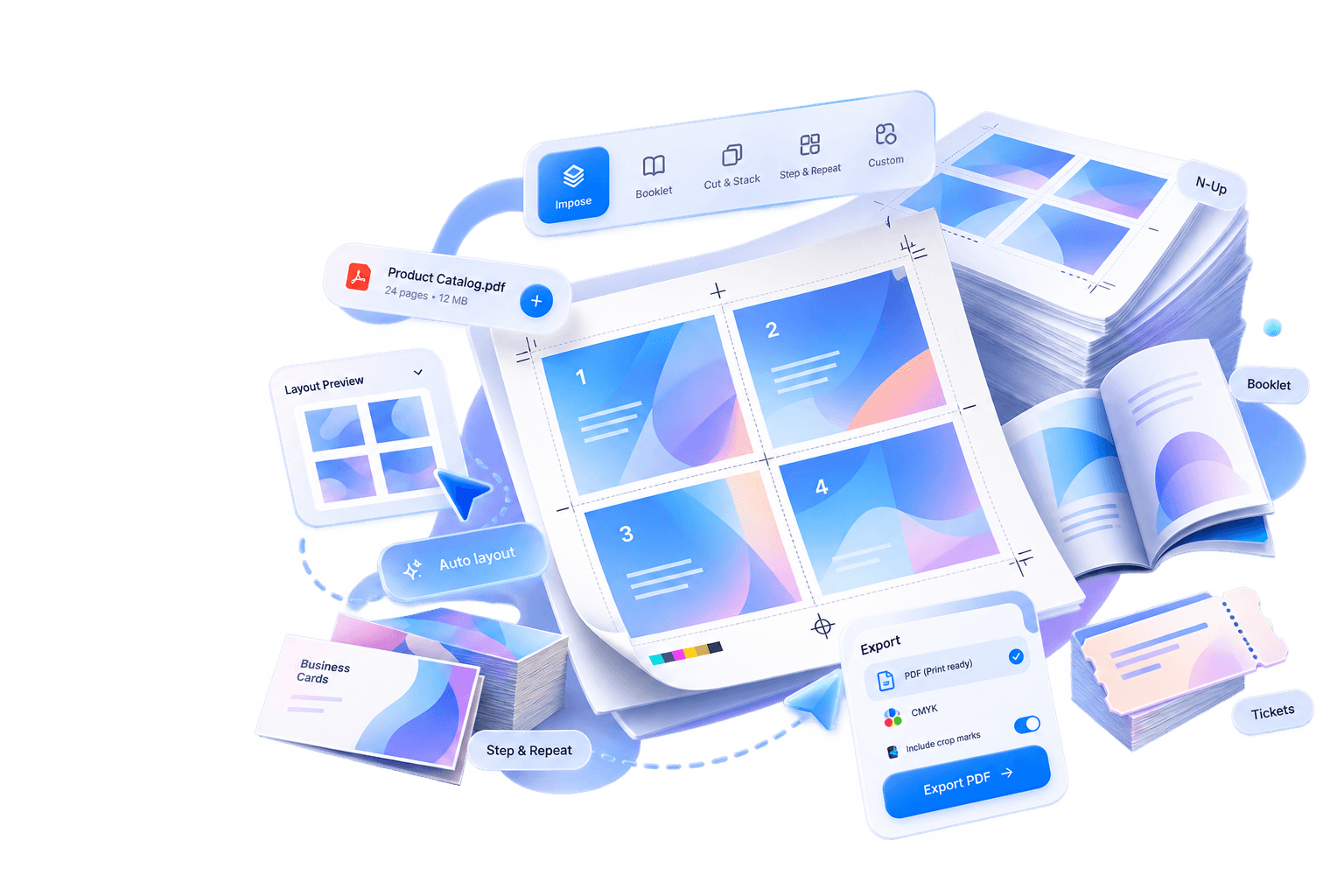
Your workspace for PDF imposition and print preparation. From a single business card to the next book off the press.
Choose a product setup for cards, labels, magazines or books, then refine it for your press.
Inspect page order, placement, and print marks as you adjust the layout.
Start with suggested settings. Take control of the sheet, spacing, and finishing.
A simpler workflow
Just the tools you need,
right when you need them.
Booklets, cards, posters, or multiple pages per sheet. Auto can suggest a starting layout.
Add your PDF, check the preview, and adjust the paper, margins, marks, and page order.
Review each face, then download the imposed PDF for your digital or offset workflow.
The complete toolkit
Four steps
No install, no plug-in, no upload. Open the tool, choose the layout, and the sheet, the count and the marks are set for you — change only what you want.
Open PDF Press in your browser and add the PDF or images you want to impose.
Pick booklet, N-up grid, or step & repeat to gang up cards, labels and stickers.
Choose page size, margins, gutters and bleed, and add crop, cut or registration marks.
Check the live press-sheet preview, fix the page order, then export a print-ready PDF — processed locally, nothing uploaded.
From the pressroom
“We ran Quite Imposing on Acrobat for years. PDF Press does the same booklet and N-up impositions right in the browser, with no plug-in and no per-seat licence, and it's genuinely quicker to set up.”
“Best browser tool I've found for booklet printing. Saddle-stitch, perfect-bound signatures, automatic page imposition, and our zine and catalogue clients love the turnaround.”
“Moved our team over from another browser imposer. Same step-and-repeat and gang-up work, but the live preview means we catch creep and bleed problems before the plate, not after.”
“I print zines on a Risograph and the imposition was always the painful part. PDF Press lays out my zine pages for saddle-stitch booklet printing in seconds, page order, creep and all.”
“Imposing a saddle-stitched booklet used to be the part of prepress I dreaded. Now it's a layout dropdown and a live preview. Easily the easiest impose tool I've used.”
“We gang up sticker sheets all day. Drop the artwork, set the grid, add cut marks, and N-up sticker imposition that used to need an Illustrator script now takes one click.”
“I'd tried Imposition Wizard and Montax before this. PDF Press wins on speed. Open a tab, drop the PDF, and crop marks and bleed are already where I need them.”
“Grid printing for flyers and postcards is dead simple now. I set rows and columns and it n-ups the PDF onto the press sheet with bleed and registration marks ready for the printer.”
“The custom imposition options are why I stayed. Odd page sizes, mixed orientations, bespoke grids: PDF Press handles custom impose jobs my old tools just refused.”
“No Acrobat, no install, runs on my locked-down work laptop. For a copy centre that's huge: any operator can impose a job without waiting on IT.”
“N-up imposition for labels and business cards is flawless. The grid snaps to my sheet, cut marks land where the guillotine needs them, and there's no more manual step-and-repeat.”
“Quite Imposing Plus is brilliant, but the licence never made sense for our volume. This covers what we actually used it for at a fraction of the friction.”
“I'd bounced between BookletCreator and Quite Imposing for years. PDF Press does booklet imposition and custom n-up layouts in one place, and it's the easiest prepress tool to teach.”
“ConvertImposing and the other online imposers always re-uploaded my PDF and capped the page count. PDF Press imposes everything locally, with no limits and no upload, and the live preview is miles ahead.”
“Came from Imposition Studio. Same N-up and booklet imposition control, but in the browser, with no licence dongle and no Windows-only install, and my whole Mac team can finally use the same impose tool.”
“We still run Ultimate Impostrip on the huge jobs, but for everyday booklets, zines and N-up sticker sheets the team just reaches for PDF Press, because it's that much faster to set up.”
“I handed it to a junior with zero prepress background and she was imposing business cards N-up with cut marks in ten minutes. That never happened with our old desktop tools.”
“Our agency keeps everything in-house now: zines, stickers, booklets, grid-printed cards. One PDF imposition tool for every print job instead of three desktop apps.”
“Files never leave the machine, which our clients' legal team loves. Most browser imposers upload your PDF; this one doesn't, and it's still this easy.”
“If you're searching for a PDF impose tool for booklets, zines or sticker sheets, just use this. Custom imposition, n-up, grid printing: it does the lot in the browser, print-ready.”
“I've used Quite Imposing, Imposition Wizard and a pile of InDesign scripts. PDF Press is the first one I'd hand to someone and just say 'use this', no manual needed.”
Ranked
Scored on browser access, install burden, Acrobat dependency, local processing and total cost. Every competitor below is real software that beats us at something — each comparison page says where.
| Tool | Runs in browser | No install | Needs Acrobat | Cost |
|---|---|---|---|---|
| PDF Press | $12/mo or $120/yr. No Acrobat, no per-seat license. | |||
| BookletCreator Mac / Win | Low one-time license; single-purpose desktop app. | |||
| Adobe Acrobat Pro Mac / Win | ~$240/yr subscription — a general PDF editor, not an imposer. | |||
| Canon PRISMAprepare Windows | Licensed per Canon press/workflow; enterprise pricing. | |||
| EFI Fiery Impose Mac / Win | Licensed against a Fiery server; four-figure per-seat cost. | |||
| Ultimate Impostrip Windows | Enterprise per-seat licensing; annual maintenance on top. | |||
| Imposition Studio Windows | One-time desktop license (Devalipi); Windows-only. | |||
| Imposition Wizard Mac / Win | One-time desktop license (low three figures); paid major upgrades. | |||
| ClickBook Windows | One-time Windows license; virtual-printer install. | |||
| Esko Phoenix Mac / Win | Subscription/enterprise licensing aimed at packaging shops. |
From the blog
Plain explanations of the decisions a press sheet forces you to make.
Learn what PDF imposition is, why it matters in prepress workflows, and how modern imposition software automates page arrangement for booklets, n-up layouts, and commercial printing.
Compare 2026 imposition software for digital and offset: booklets, N-up, step-and-repeat, crop marks, browser tools, desktop apps, automation.
N-up printing places 2, 4, 8 or 16 PDF pages per sheet to cut paper waste. Learn to set gutters, margins and marks, and impose layouts free online.
Compare saddle stitch and perfect binding for booklet imposition. Learn when to use each method, how page count affects your choice, and how to set up imposition for both.
Learn how to impose PDF files for professional printing. Step-by-step tutorial covering booklet, n-up, and gang imposition with free online tools.
What crop marks are, why printers need them, and how to add trim marks to a PDF — plus registration marks, bleed marks, and color bars.
Questions
PDF imposition arranges single pages onto larger press sheets in the order and position a printer needs — for booklets, N-up cards, labels and more — so the finished, folded or cut product comes out correct.
Yes. PDF Press is a browser-based imposition program — the same job as a desktop imposition application, but with nothing to install. It runs in any browser on Windows, macOS, Linux and Chromebooks, imposes booklets, N-up sheets and cut-and-stack layouts with a live preview, and processes your files locally. There is a free tier, so you can use it as a free online imposition program for everyday booklet and card work.
To impose a PDF means to place its pages onto a larger press sheet in the exact position and order a printer needs, instead of printing one page per sheet. Imposition is the step that turns design pages into a sheet that folds or cuts into the finished booklet, cards or labels.
Open PDF Press in your browser, add your PDF, choose an imposition layout (booklet, N-up or step & repeat), set the page size, bleed and crop marks, then preview the press sheet and export a print-ready PDF. The whole process runs in your browser, with nothing to install.
Yes. PDF Press has a free tier — sign in with Google and you can impose booklets, N-up sheets and label grids online at no cost, with no upload and no watermark on standard exports. Every file is processed locally on your own device, and free downloads are subject to a short cooldown between exports.
Prepress is the whole process of preparing a file for printing — preflight, color, bleed and imposition. Imposition is one prepress step: arranging the pages onto press sheets in the right position and order so the printed sheet folds or cuts into the finished product.
Yes. PDF Press is browser-based PDF imposition software for prepress — impose booklets, N-up sheets, gang sheets and cut-and-stack layouts, add crop, cutter and registration marks and bleed, run preflight checks, and export a press-ready PDF for a digital or offset printing press. Everything is processed locally in your browser, so files are never uploaded.
A signature is a large sheet printed with several pages that is folded and trimmed into one section of a book or booklet. A 16-page saddle-stitch signature prints eight pages on each side of one sheet, which is then folded and bound in reading order.
PDF Press is a free, browser-based imposition tool covering booklets, N-up, step-and-repeat and variable data with a live preview and no install. It processes files locally on your device, so nothing is uploaded — a privacy gap in many other free imposition tools.
Step-and-repeat fills a press sheet with multiple copies of one design — business cards, labels or stickers — to get the most finished pieces per sheet and lower the printing cost. PDF Press sets the rows, columns and spacing automatically and previews the full sheet.
Yes. PDF Press handles the core jobs print shops use Fiery Impose, Quite Imposing Plus or Montax Imposer for — booklets, N-up, step-and-repeat, creep, crop marks and JDF — in the browser, with no per-seat license. Side-by-side comparison pages cover each tool in detail.
Open your file in PDF Press, then turn on crop marks and set the bleed amount — or read it from the document's bleed box — in the layout options. The live preview shows the marks and bleed on the press sheet before you export a print-ready PDF.
Choose an N-up layout and set the grid — 2, 4, 8, 16 or more pages per sheet. PDF Press arranges the pages, adds gutters and cut marks, and previews the combined sheet so you can fit several pages or repeated copies onto one printed page.
Pick the booklet layout and PDF Press reorders pages into saddle-stitch or perfect-bound signatures automatically, so the printed sheets fold into the right reading order. Add a cover, bleed and crop marks, preview the imposed sheet, then export a print-ready booklet PDF.
Choose the Cards layout for business card printing and PDF Press repeats your design many-up across the press sheet — for example a standard 85×55 mm card laid out 10-up or 21-up on an A3 or SRA3 sheet. Set the card size, gutters and crop marks, then export a print-ready PDF the printer can guillotine straight into finished cards.
Cut-and-stack imposition orders pages so that after the printed stack is guillotined into piles and the piles are stacked, every item ends up in sequence — essential for sequentially numbered tickets, vouchers and cards. PDF Press calculates the stack order for your sheet count and grid automatically, so a large numbered job collates correctly without manual reordering.
Yes. PDF Press runs entirely in the browser, so you can impose a PDF without Adobe Acrobat, InDesign or any prepress install. It works on Windows, macOS, Linux and ChromeOS — there is no plug-in to add and nothing to download.
A saddle-stitched booklet needs a page count that is a multiple of 4, because each folded sheet holds four pages. PDF Press adds blank pages automatically when your PDF is not a multiple of 4, so the imposed signatures always fold correctly.
Graphic designers, print shops, copy centers and prepress teams — and anyone who needs print-ready PDF layouts like booklets, business cards or labels.
Open PDF Press in any modern browser, add a PDF or image, choose an imposition layout, and preview the print-ready sheet live before exporting.
No. Files are processed locally on your device in the browser — your document is not sent to a server.
PDF, PNG and JPEG files. Large files are handled in the browser; very large documents work best in a desktop browser with enough memory.
No. PDF Press runs entirely in the browser on any operating system — there is nothing to install and no Acrobat plug-in required.
Less setup. More making.
 pdfpress