 pdfpress
Binding Methods Compared: 10 Print Binding Types
Compare 10 print binding methods: saddle stitch, perfect, case, wire-o, spiral, Coptic and more. Page counts, cost, lay-flat and imposition needs compared.
Why the Binding Method Matters More Than You Think
Every printed product with more than a single sheet needs some form of binding. The method you choose determines how pages are imposed onto press sheets, what paper stocks are compatible, whether the finished piece can lay flat, how durable it is, and what the per-unit cost will be.
Choosing the wrong method leads to real problems: a 200-page manual saddle-stitched will buckle and shed staples; a four-page menu spiral-bound will look absurd; a rare-edition art book tape-bound will crack at the spine within a year. Binding is not an afterthought -- it is an engineering decision that should be made before the first page is designed.
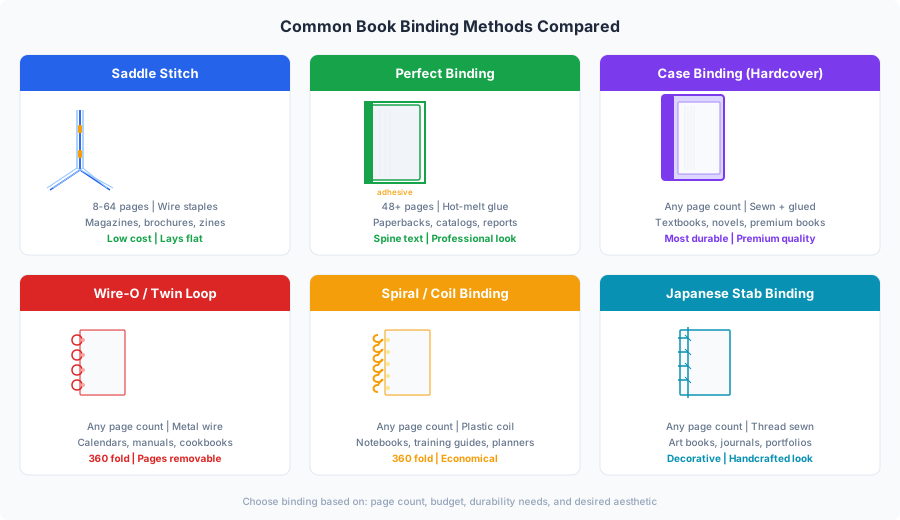
This guide covers ten binding methods used in commercial and craft print production. For each, we explain how it works, page count range, cost level, best use cases, and imposition requirements. A comparison table at the end lets you evaluate all ten side by side.
1. Saddle Stitch Binding
Saddle stitch is the most common and economical binding for thin publications. Sheets are folded in half, nested inside each other, and stapled through the spine fold with wire staples. Every magazine stapled along its spine is saddle-stitched.
A single sheet contributes four pages (front and back of each half). All sheets nest together -- the outermost carries the cover and last pages, the innermost carries the center spread. The bundle is stapled and trimmed on three sides.
Page count: 8-64 (must be a multiple of 4). Sweet spot is 8-48 pages. Beyond 48, paper thickness causes severe creep and staples may not penetrate all layers.
Cost: Very low -- the cheapest commercial binding method.
Best for: Magazines, newsletters, event programs, comic books, product catalogs, mailed marketing pieces.
Imposition: All pages in one nested set with non-sequential page order. Creep compensation (progressive inward shift on inner sheets) is essential for 12+ pages. PDF Press handles this automatically. See our saddle stitch vs perfect binding guide for a deeper comparison.
2. Perfect Binding
Perfect binding is the standard method for paperback books and thick magazines. Pages or folded signatures are gathered into a block, the spine edge is roughened, adhesive (EVA hot-melt or PUR) is applied, and a cover wraps around the glued spine. The flat spine with a printed title is its hallmark.
Pages are organized into signatures (typically 8, 16, or 32 pages each), gathered in sequence, milled at the spine, glued, and trimmed on three non-spine edges.
Page count: 48-800+. Minimum depends on paper weight -- at least ~3mm spine thickness (roughly 48 pages of 80gsm) for the adhesive to hold.
Cost: Moderate -- higher than saddle stitch due to adhesive equipment and cover wrapping.
Best for: Paperback books, thick magazines, annual reports, training manuals, academic journals, product catalogs.
Imposition: Each signature is imposed independently. No creep compensation needed since signatures are gathered, not nested. Partial signatures require blank page insertion. PDF Press supports configurable signature sizes. See our detailed comparison.
3. Case Binding (Hardcover)
Case binding is the premium method for hardcover books. A text block of sewn or glued signatures is attached to rigid board covers wrapped in cloth, leather, or printed paper. Endpapers connect the text block to the case, and a fabric mull reinforces the spine.
Signatures are printed, folded, sewn together (Smyth sewing), trimmed, and reinforced with headbands and mull. Separately, the case is constructed and covered. The text block is then "cased in" by gluing the endpapers to the covers.
Page count: 32-1000+. No practical upper limit; very thick books may split into volumes.
Cost: High -- typically 2-5x more than perfect binding due to sewing, case construction, covering, and finishing.
Best for: Hardcover novels, coffee-table art books, children's picture books, library and reference volumes, limited editions, corporate gift books.
Imposition: Signature imposition is identical to perfect binding. Additional layouts needed for endpapers (4-page fold), cover (accounting for spine width, board thickness, and turn-in), and dust jacket if applicable. Spine width calculation depends on page count, paper thickness, and thread bulk. See our case binding imposition guide.
4. Wire-O / Twin-Loop Binding
Wire-O binding uses continuous double-loop wire rings inserted through rectangular punched holes along the binding edge. Pages turn 360 degrees and lay completely flat. It is the premium mechanical binding, looking significantly more polished than plastic spiral coil.
Printed and trimmed pages are collated, punched with rectangular holes (3:1 or 2:1 pitch), and a pre-formed wire element is threaded through and closed with a wire-closing machine.
Page count: 4-300+. Wire gauge is matched to document thickness, from 1/4" (~30 sheets) to 1-1/4" (~280 sheets).
Cost: Moderate to high -- wire elements cost more than coils, and equipment is specialized.
Best for: Calendars, cookbooks, corporate presentations, technical manuals, planners, music scores.
Imposition: Cut-sheet imposition -- pages are in reading order, not reordered. The critical parameter is the binding margin: punch holes consume ~5-8mm along the binding edge, which must be clear of content. For efficient printing, gang multiple pages on larger sheets. See our Wire-O binding imposition guide.
5. Spiral / Coil Binding
Spiral binding uses a continuous plastic or metal coil threaded through round punched holes. Like Wire-O, it allows 360-degree rotation and lays flat. It is the workhorse of office, educational, and short-run production -- inexpensive, fast, and available at nearly every print shop.
Pages are collated, punched with round holes, and a coil is fed through using a coil inserter. The ends are crimped to prevent unwinding.
Page count: 4-400+. Coil diameter ranges from 6mm (~15 sheets) to 50mm (~440 sheets).
Cost: Low to moderate -- one of the cheapest methods after saddle stitch and stapling.
Best for: School reports, training manuals, course materials, reference documents, notebooks, budget cookbooks.
Imposition: Cut-sheet imposition in reading order. Binding margin is slightly larger than Wire-O (~8-12mm) because coil loops are wider. For n-up gang layouts, the binding edge must be consistently positioned so the punch aligns across all pages in the stack.
6. Japanese Stab Binding
Japanese stab binding is a traditional technique where stacked pages are sewn through holes punched near the spine edge. The thread forms visible decorative patterns -- four-hole (yotsume toji), hemp-leaf (asa-no-ha toji), or tortoise-shell (kikko toji). Unlike Western methods that hide the mechanism, stab binding makes the stitching a design element.
Pages are stacked in reading order with covers, clamped, and punched 10-15mm from the spine edge. Thread is passed through in a specific decorative pattern, wrapping around the spine and sometimes the top and bottom edges.
Page count: 8-80. Works best with thin stacks since the sewing goes through the full thickness at once.
Cost: Low (handmade) to high (commercial) -- labor-intensive and not easily mechanized.
Best for: Artist books, handmade zines, wedding programs, design presentations, gift books, small-run exhibition catalogs.
Imposition: Single-sheet imposition in reading order. The stab margin (15-20mm along the binding edge hidden by sewing) must be completely clear of content. For double-sided printing, the inner margin on each page must be wide enough to accommodate the stab area.
7. Coptic Binding
Coptic binding originated with the Coptic Christians of Egypt (2nd-4th centuries). It uses an exposed chain stitch linking individual signatures directly to cover boards without a spine piece. The result is a book that opens completely flat -- even more than saddle stitch -- because only flexible thread holds the signatures together.
Folded signatures are linked using a chain stitch through holes in each signature's spine fold. The sewing starts at the first signature, passes through the cover board, and chains through each subsequent signature. No adhesive is used for the binding itself.
Page count: 16-300+. Very versatile -- typically 4-20 signatures of 8-16 pages each.
Cost: Moderate (handmade) to very high (commercial) -- each signature is sewn individually, making it impractical to mechanize at scale.
Best for: Art journals, fine-art photo books, handmade journals and guest books, limited-edition literary works, archival rebinding.
Imposition: Signature-based, identical to perfect binding. Each signature (typically 8 or 16 pages) is imposed for its fold. No endpapers or spine piece needed. The gutter margin must accommodate 3-5 sewing stations spaced along the spine fold.
8. Section Sewing (Smyth Sewing)
Section sewing stitches through the spine fold of individual signatures with thread, linking them together into a durable text block. It is not a standalone binding method but a text block construction technique that precedes case binding or perfect binding cover application ("sewn perfect binding").
Each signature is sewn through its fold using a Smyth sewing machine, with thread passing in and out at multiple sewing stations. Each signature links to the previous one, creating a flexible, durable block.
Page count: 32-1000+. The preferred method for books that must last decades.
Cost: Moderate to high. Industrial machines are fast but expensive; hand sewing is slow.
Best for: Library hardcovers, Bibles and prayer books, reference works, high-quality paperbacks, any book expected to last 50+ years.
Imposition: Identical to perfect/case binding at the signature level. The gutter margin must accommodate sewing stations (add 3-5mm). Some automated sewing lines require station marks or notches in the signature fold.
9. Tape Binding (Thermal Binding)
Tape binding uses a pre-glued fabric or plastic strip that wraps around the spine. The document is inserted into the tape channel, and heat activates the adhesive, bonding pages in seconds. It occupies the niche between stapling and perfect binding -- faster and more polished than stapling, cheaper and simpler than true perfect binding.
Pages are collated and jogged. A tape strip is placed over the spine and the assembly is inserted into a thermal binding machine for 30-90 seconds. After cooling, the book has a fabric-covered spine.
Page count: 5-300. Tape widths accommodate varying thicknesses, with a lower minimum than perfect binding.
Cost: Low -- desktop machines start around $100-200, and tape strips cost under a dollar each.
Best for: Business reports, internal documents, academic theses, real estate presentations, legal documents, small-office binding.
Imposition: The simplest possible -- sequential page order, cut to final size. No folding, no page reordering, no creep compensation. The binding margin (~3-5mm consumed by adhesive) should be clear of content. Any imposition layout producing correct-size cut sheets works.
10. Staple Binding (Side and Corner Stapling)
Staple binding -- a staple in the corner or two along the left edge -- is the most basic binding method. Side stapling passes staples through the face of stacked pages near the binding edge, distinct from saddle stitching where staples pass through the spine fold of nested sheets.
Pages are collated and aligned, then one or more staples are driven through the stack. Industrial flat-stapling machines handle up to 60-80 sheets; standard office staplers handle ~30.
Page count: 2-80 (side stapling) or 2-30 (corner stapling with a standard stapler).
Cost: Essentially zero -- a stapler is standard equipment and staples cost fractions of a penny.
Best for: Office memos, school handouts, short reports, manuscript drafts, price lists, any document that does not need to look "published."
Imposition: No special imposition required. Pages are printed in sequential order and trimmed. Side stapling needs a 5-10mm binding margin clear of content. For n-up printing, any gang layout producing correct page sizes works.
Binding Methods Comparison Table
Use this table as a quick reference when choosing the right binding for your project:
| Method | Pages | Cost | Lay-Flat | Spine Text | Durability | Imposition Type |
|---|---|---|---|---|---|---|
| Saddle Stitch | 8-64 | Very Low | Yes | No | Moderate | Nested signatures + creep |
| Perfect Binding | 48-800+ | Moderate | Limited | Yes | High | Independent signatures |
| Case Binding | 32-1000+ | High | Good | Yes | Very High | Signatures + endpapers + cover |
| Wire-O | 4-300+ | Mod-High | Yes (360°) | No | High | Cut sheets + punch margin |
| Spiral / Coil | 4-400+ | Low-Mod | Yes (360°) | No | Moderate | Cut sheets + punch margin |
| Japanese Stab | 8-80 | Low-High* | No | No | Moderate | Cut sheets + stab margin |
| Coptic | 16-300+ | Mod-High | Yes (fully) | No | Very High | Signature-based (like perfect) |
| Section Sewing | 32-1000+ | Mod-High | Good | Yes** | Very High | Signatures + sewing stations |
| Tape Binding | 5-300 | Low | No | No | Low-Mod | Sequential cut sheets |
| Staple Binding | 2-80 | Negligible | No | No | Low | Sequential cut sheets |
* Japanese stab binding is inexpensive handmade but costly commercially due to labor.
** Section sewing is a text block technique; spine text depends on the cover method applied after sewing.
Methods using signature-based imposition (saddle stitch, perfect, case, Coptic, section sewing) are the most complex to impose but produce the most professional results. Methods using cut-sheet imposition (Wire-O, spiral, Japanese stab, tape, staple) are simpler but may need specialized margin calculations. PDF Press supports signature-based methods through its Booklet and N-up Book tools, and cut-sheet methods through Grid, Cards, and Gang Sheet tools.
How to Choose the Right Binding Method
Most projects narrow to two or three candidates based on a few key questions:
1. What is the page count? Under 48 pages: saddle stitch unless you need a premium look. 48-200 pages: perfect binding is the default. Over 200 pages with maximum durability: case binding with section sewing. Mechanical bindings (Wire-O, spiral) work across a broad range.
2. What is the budget? Work from cheapest up: stapling, saddle stitch, tape, spiral, perfect, Wire-O, case. The first method meeting your functional and aesthetic needs is your answer.
3. Must it lay flat? For documents used open on a desk (cookbooks, technical manuals, music scores), choose saddle stitch, Wire-O, spiral, or Coptic. Perfect binding and tape resist opening flat.
4. Do you need spine text? For shelf identification, you need a flat spine: perfect binding, case binding, or section sewing with a covered spine.
5. Commercial or handmade? Japanese stab and Coptic are craft methods -- beautiful but labor-intensive. For runs of 500+, use mechanizable methods: saddle stitch, perfect, case, Wire-O, or spiral.
6. How long must it last? Archival (decades+): section-sewn case binding. Regular use (5-10 years): perfect or Wire-O. Short-term (weeks to months): saddle stitch, tape, or stapling.
When in doubt, start simple. A saddle-stitched booklet that ships on time is better than a case-bound book that blows the budget.
Setting Up Imposition for Any Binding Method
Every imposition job reduces to one question: how do I arrange source pages on press sheets so they end up in the correct order after printing, cutting, folding, and binding? The answer depends on which imposition category your binding method falls into:
Signature-based imposition (saddle stitch, perfect, case, Coptic, section sewing): Pages must be reordered and arranged so that when the sheet is folded, pages read in sequence. This is where imposition software provides the most value. In PDF Press, the Booklet tool handles saddle stitch and perfect binding with automatic page reordering, creep compensation, and configurable signature sizes.
Cut-sheet imposition with margin constraints (Wire-O, spiral, Japanese stab): Pages are in reading order but need specialized margins for punch holes or sewing. In PDF Press, the Grid and Cards tools let you define custom per-edge margins, ensuring the binding margin is wider than trim margins elsewhere.
Simple sequential imposition (tape, staple): Pages in reading order with no special margins beyond standard. Any imposition layout producing correct-size cut sheets works. PDF Press's Grid tool with standard margins handles this cleanly.
For all categories, PDF Press provides a real-time preview showing exactly how pages will appear on the press sheet before you print. Upload your PDF, select the appropriate tool, configure binding parameters, verify visually, and download the imposed PDF ready for your printer.
Frequently Asked Questions
What is the cheapest binding method for printing?
Which binding method allows a book to lay completely flat?
How many pages do I need for perfect binding?
What is the difference between Wire-O and spiral binding?
What binding method is used for hardcover books?
Do I need imposition software for Wire-O or spiral binding?
What is Japanese stab binding and when should I use it?
Can PDF Press handle imposition for all binding types?
Ready to put this into practice?
Do it in your browser — the sheet, the count and the marks are set for you. Change only what you want.
Open the n up toolFree in your browser · sign in with Google · files never leave your device