Grid
Unlike Cards (which repeats the same page), Grid assigns consecutive source pages to grid cells in reading order. A 2×2 grid on Letter paper fits 4 different pages per sheet. Useful for N-up printing, proofing, contact sheets, and arranging multiple items on shared press sheets.
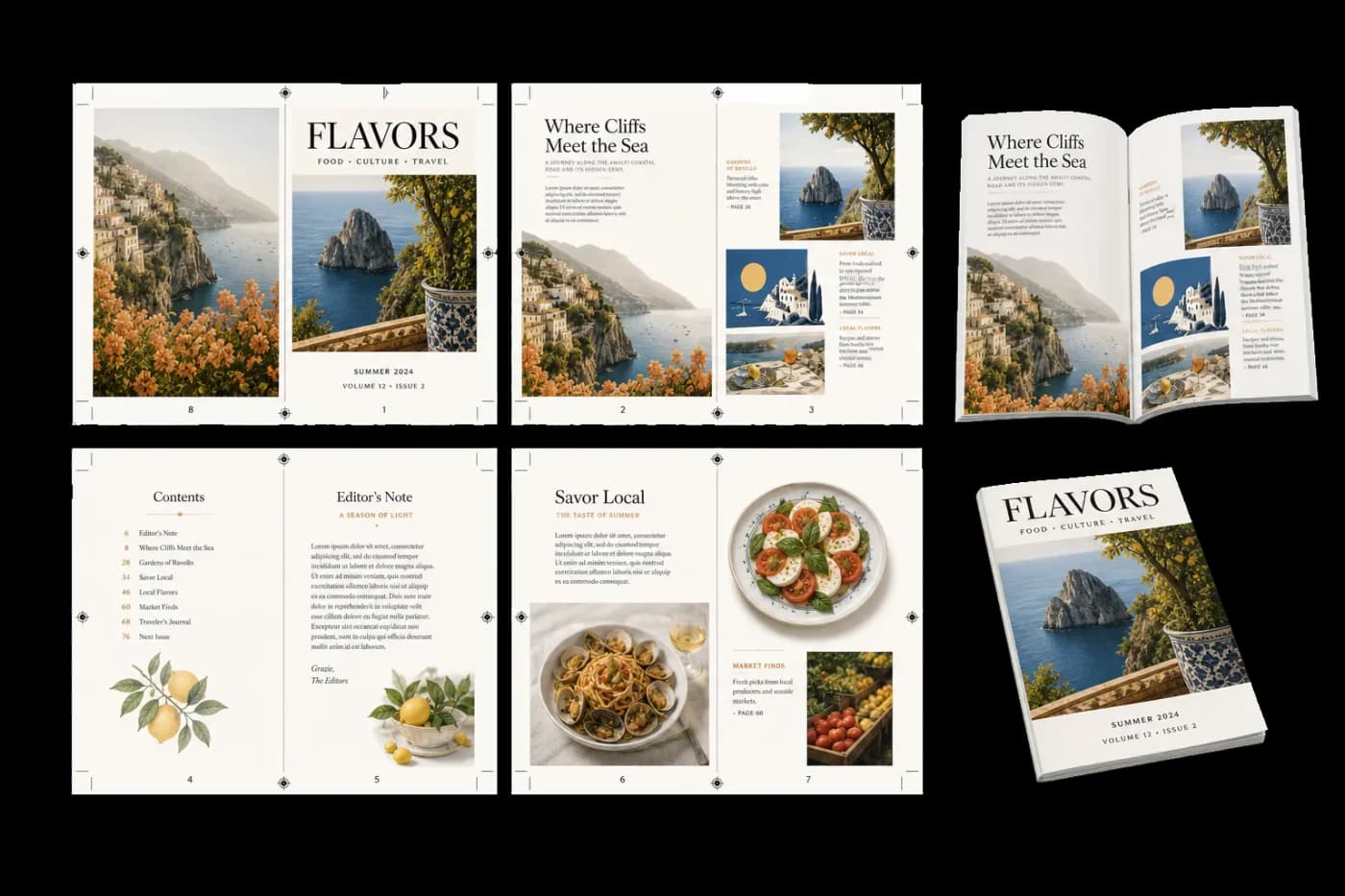
Places different source pages into a grid layout: each cell holds a different page.
Unlike Cards (which repeats the same page), Grid assigns consecutive source pages to grid cells in reading order. A 2×2 grid on Letter paper fits 4 different pages per sheet. Useful for N-up printing, proofing, contact sheets, and arranging multiple items on shared press sheets.
How It Works
Unlike Cards (which repeats the same page), Grid assigns consecutive source pages to grid cells in reading order. A 2×2 grid on Letter paper fits 4 different pages per sheet. Useful for N-up printing, proofing, contact sheets, and arranging multiple items on shared press sheets.
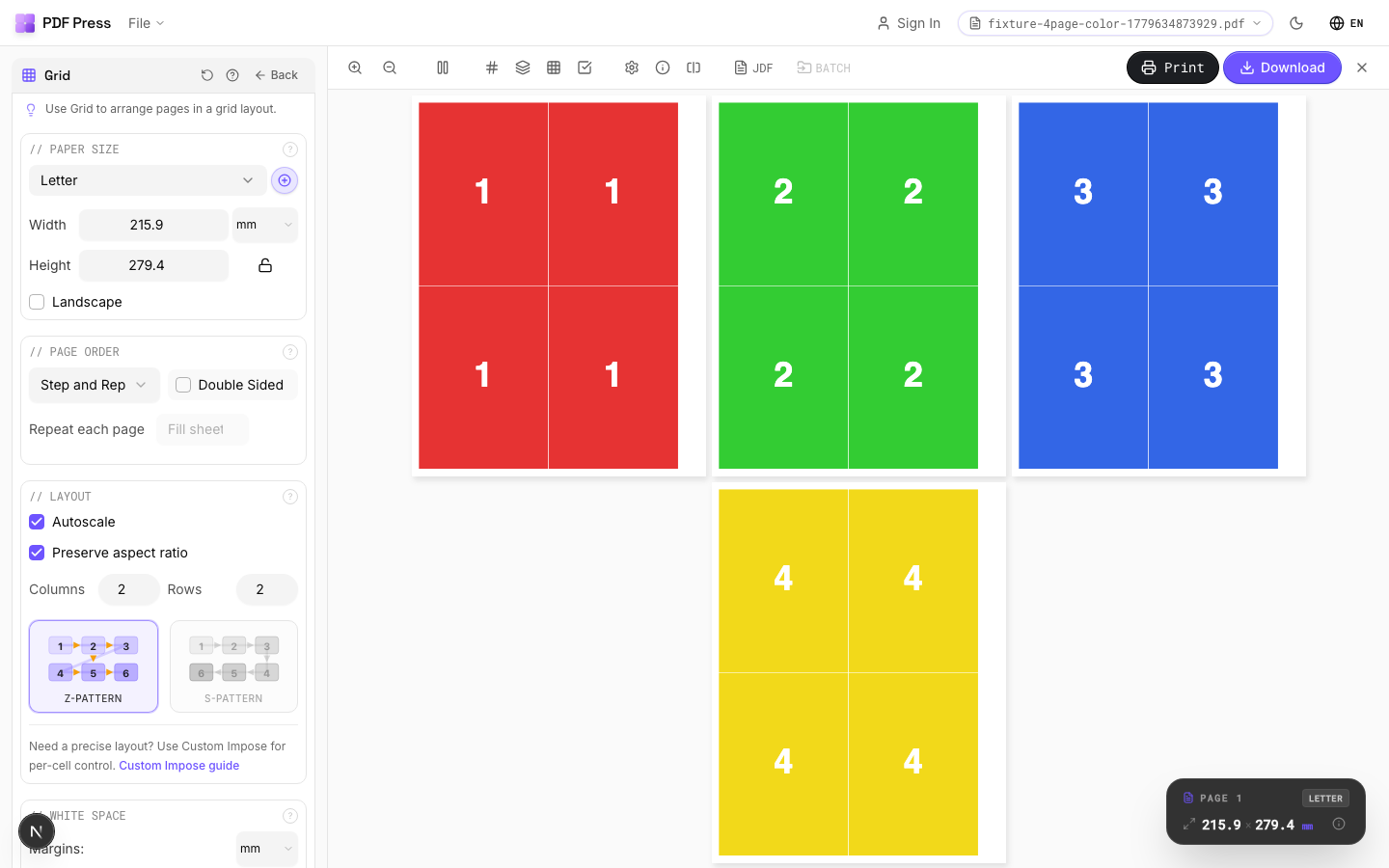
Grid tool applied. Options panel on the left, imposed result on the right. Click to zoom.
Options Guide
Paper Size
Sets the output sheet dimensions. This is the physical paper going through your printer or press.
Standard presets: Letter (8.5×11in), Legal (8.5×14in), Tabloid (11×17in), A4 (210×297mm), A3 (297×420mm). Landscape swaps width↔height. Lock icon links dimensions to preserve aspect ratio. Custom lets you enter any size in inches, mm, or points (1in = 72pt = 25.4mm).
White Space
Controls margins around the sheet edges and gutters between items in the grid.
Left margin = space from the left sheet edge to the first column. Top margin = space from the top edge to the first row. Horizontal gutter = gap between columns. Vertical gutter = gap between rows. All values are in your selected unit (inches/mm/points). 'Center output on page' distributes leftover space evenly instead of anchoring content to the top-left corner.
Printer's Marks
Adds trim guides and alignment marks outside the live area for accurate cutting and registration.
Crop marks: short lines at each corner showing where to trim. Center marks: crosshairs at sheet midpoints for front/back alignment on duplex jobs. Line length (default 0.43in/31pt): how long each mark line extends. Line thickness (default 0.014in/1pt): mark stroke weight. Line distance (default 0.139in/10pt): gap between the mark and the artwork edge. Four-color black: prints marks in C+M+Y+K for visibility on color proofs. Knockout: adds a white halo around marks so they show on dark backgrounds.
Bleeds
Extends artwork beyond the trim edge to prevent white strips after cutting.
Three modes: 'No bleeds' trims exactly at the page boundary. 'Pull from document' uses bleed info already embedded in the PDF (TrimBox/BleedBox metadata). 'Fixed' lets you manually set bleed on each side, typically 3mm (0.125in / 9pt) for commercial print, 1-2mm for digital. Bleed values define how far past the trim edge the artwork extends.
Page Order
Controls the reading direction and page assignment order in the grid.
Left-to-right: fills cells in Western reading order (top-left first). Right-to-left: starts from the top-right corner: for RTL languages (Arabic, Hebrew) or specific finishing workflows. Direction affects both single-sided and double-sided layouts.
Layout
Set columns, rows, page filling pattern, and scaling behavior.
Sequential: pages fill cells left→right, top→bottom, then next sheet. Stack (cut-and-stack): reorders pages so that after printing, cutting into strips, and stacking, pages are in reading order — saves manual collation. Step-and-repeat: fills the entire sheet with copies of each page before moving to the next (like Cards but within Grid's framework). Double-sided pairs sheets for front/back printing.
Configurations & Variations
3×3 Grid Layout
Set columns to 3 and rows to 3 for a 9-up layout. Each cell holds a different source page in sequence. On A3 or Tabloid paper this fits 9 A6-sized pages per sheet, making it a quick way to produce proofing contact sheets.
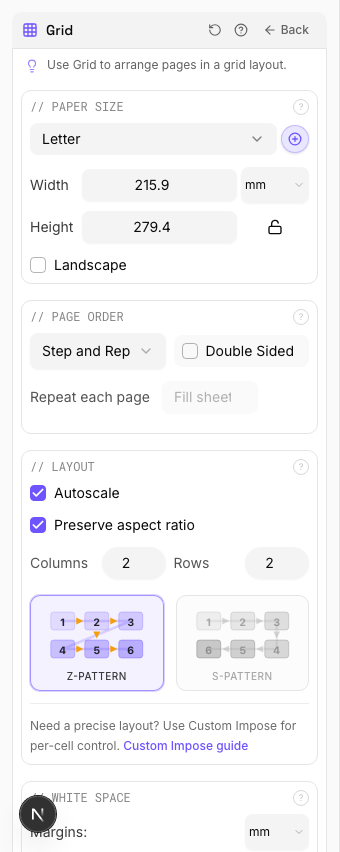
Settings to change
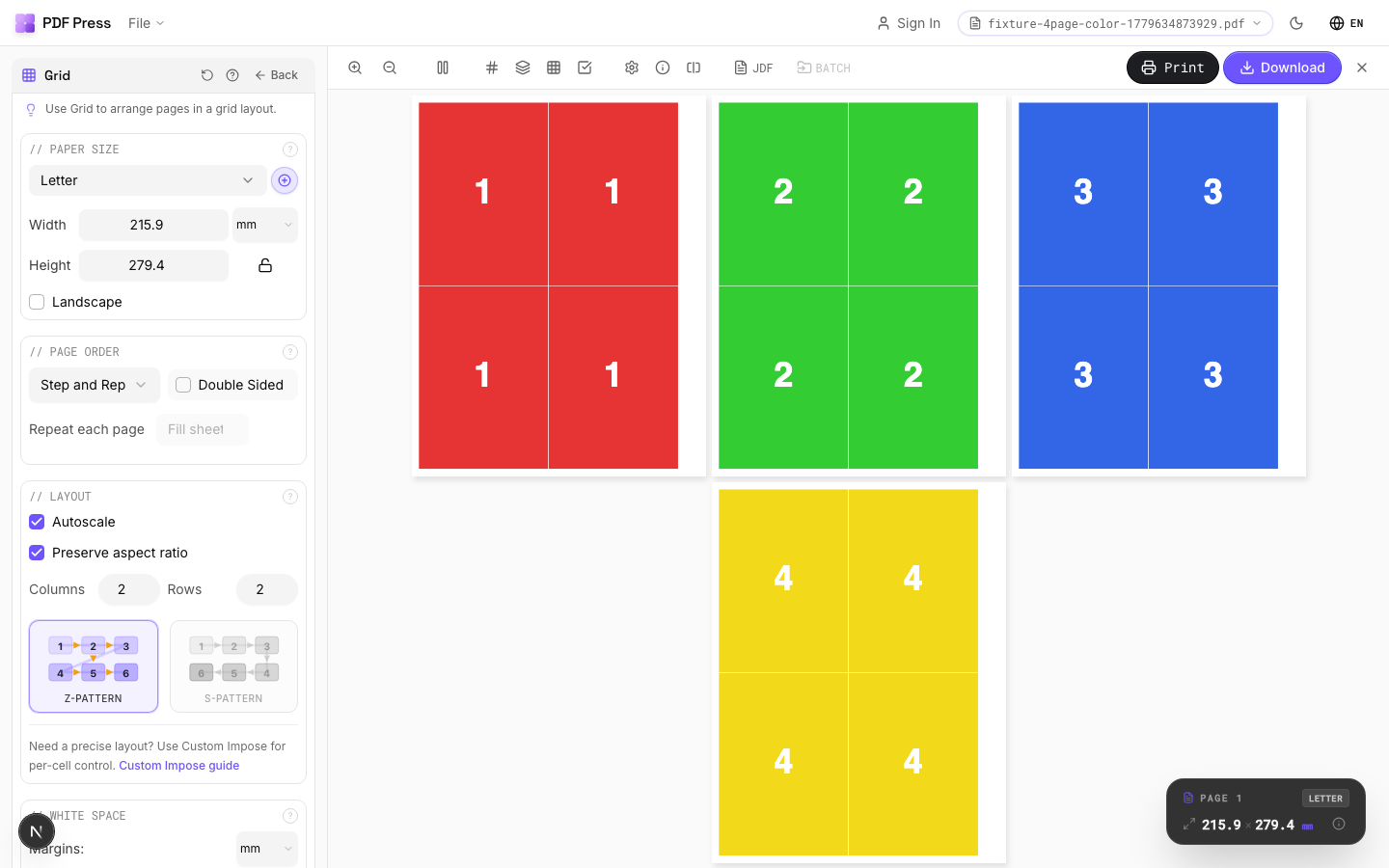
Full app view
Output result
Step and Repeat
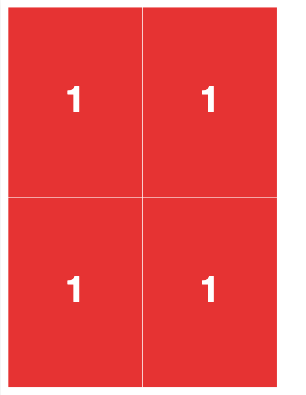
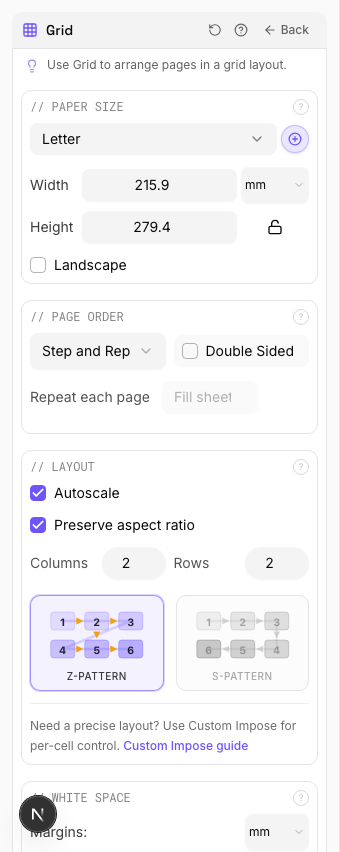
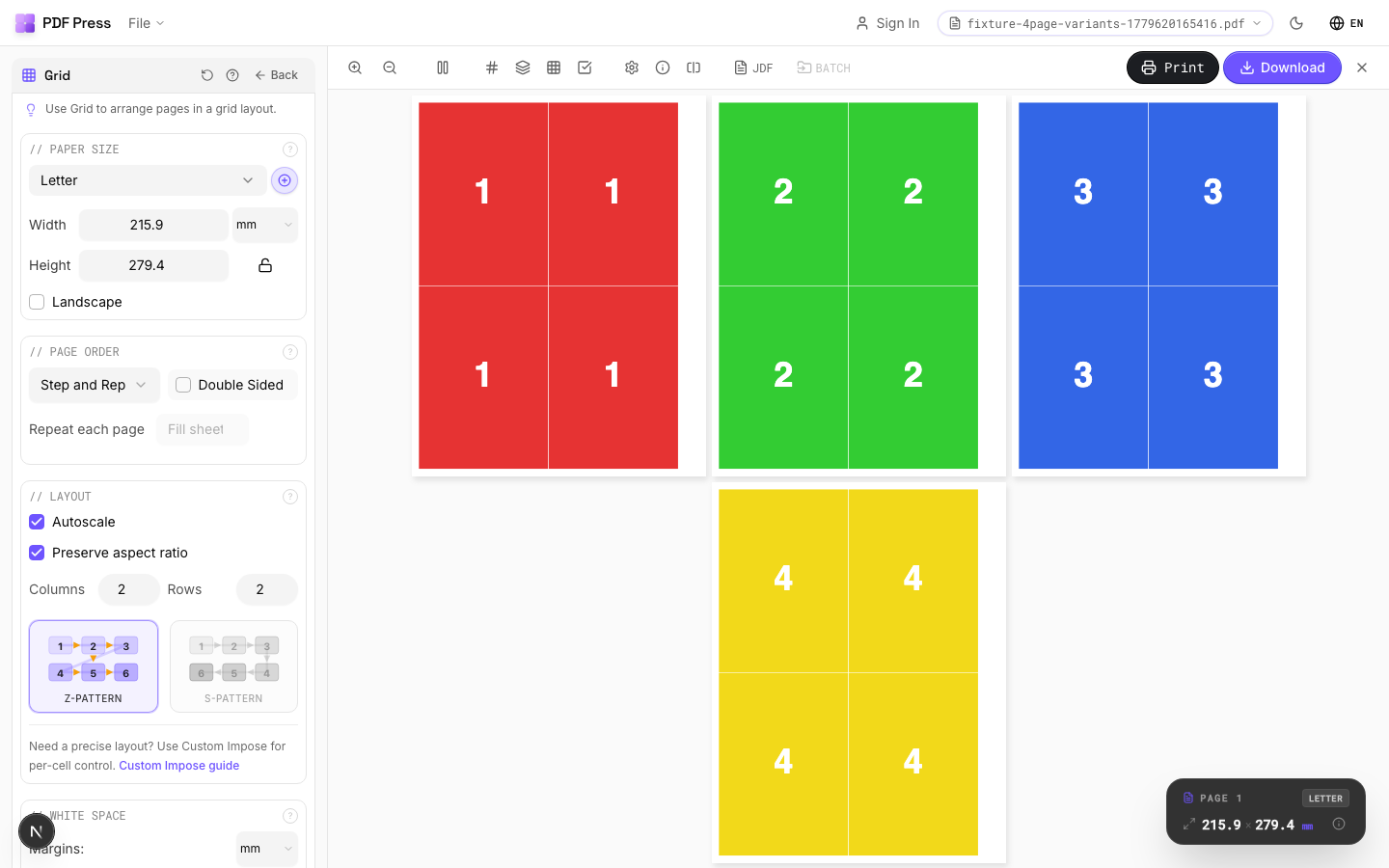
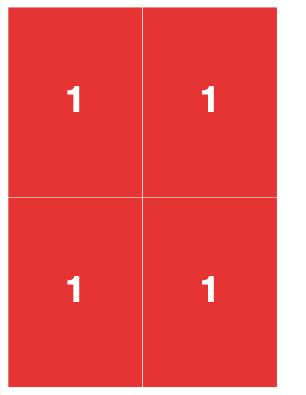
Switch to the Step and repeat fill pattern. The entire sheet fills with copies of page 1 before advancing to page 2, and so on. Unlike sequential mode (which places a different page in each cell), step-and-repeat produces multiple identical copies per sheet, similar to Cards but with Grid's margin and gutter controls.
Settings to change
Full app view
Output result
Cut-and-Stack Order
Switch the Page order to Stack (Cut-and-Stack) and tick True stack. Pages are distributed down the pile so that after printing, guillotining the whole stack, and re-stacking the cut piles, every finished bundle reads in sequence. This is the standard workflow for numbered tickets, raffle books, or any large sequential run cut on a guillotine — far faster than collating by hand.
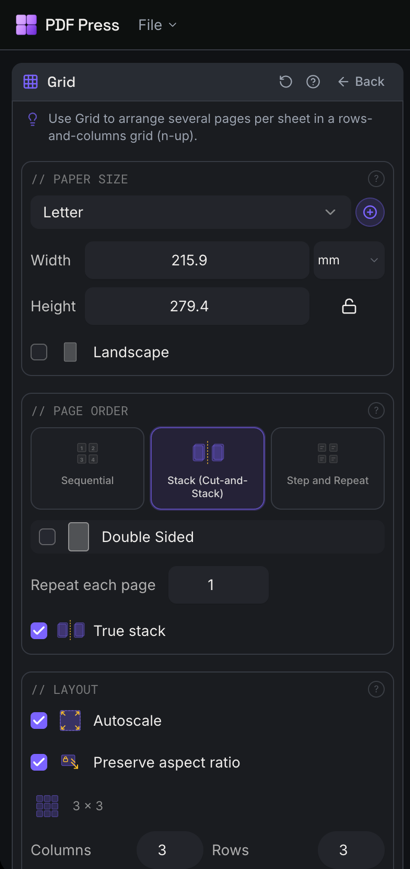
Settings to change
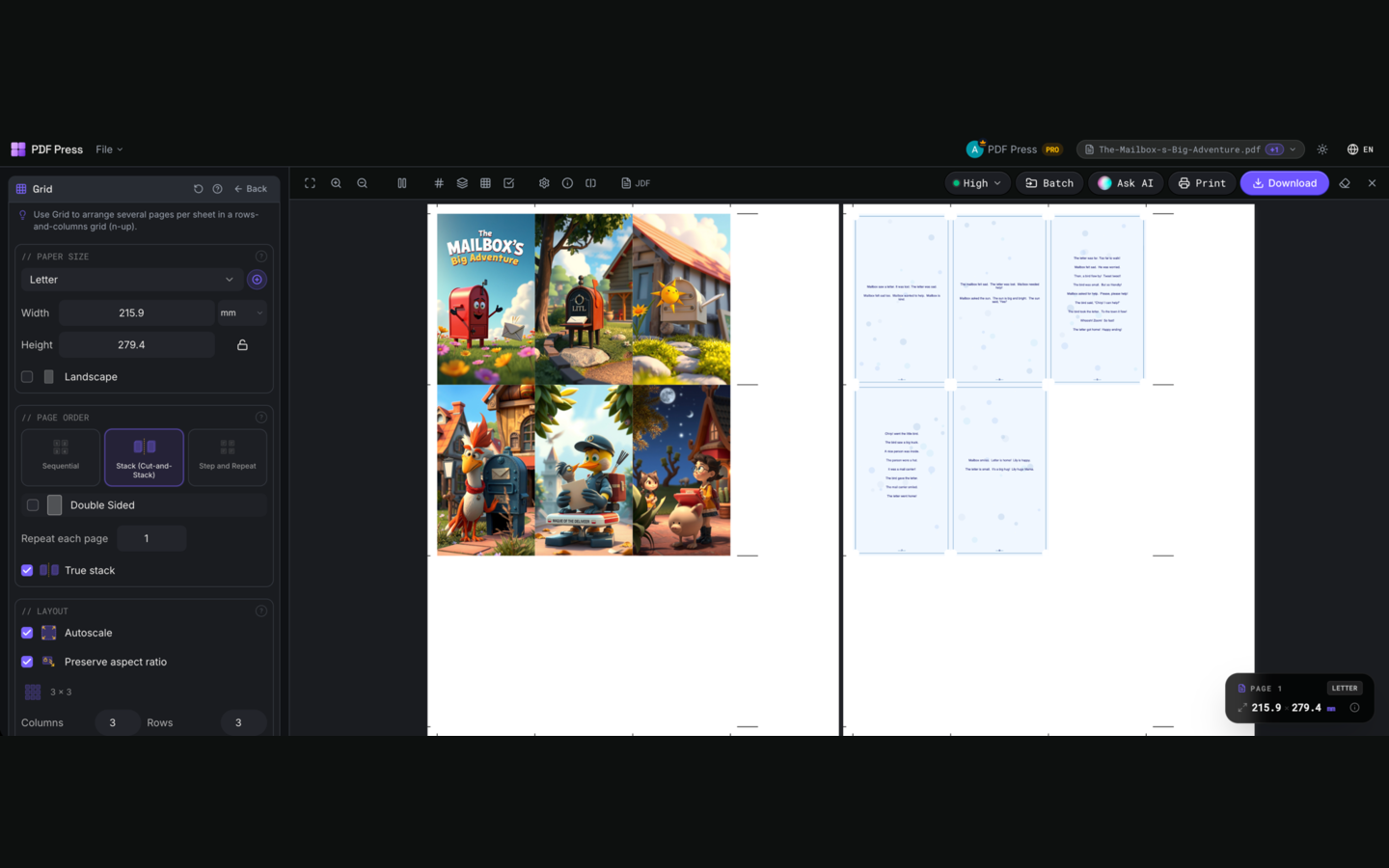
Full app view
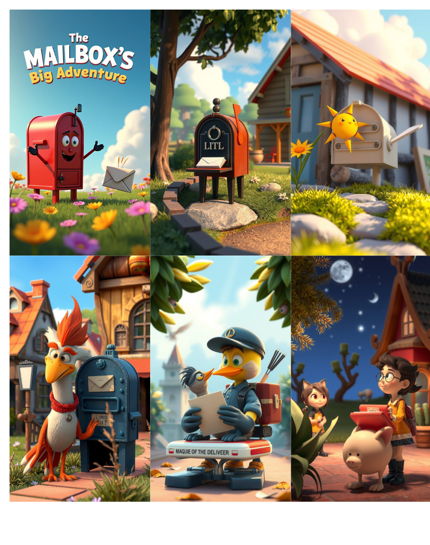
Output result
Expert Tip
For step-and-repeat work (labels, tags), set columns and rows to maximise sheet utilisation. Turn on auto-scale so the engine fits the most repeats without manual arithmetic.
Double-sided is not available in step-and-repeat mode. If you need back-printing, switch to N-up Book or Expert Grid.
Learn More
Used in Recipes
A5 Saddle-Stitch 2-Up on SRA3
Commercial A5 booklet workflow: impose on SRA4 flats, then repeat two copies on SRA3.
Playing Cards
Full deck of playing cards imposed for sheet-fed printing.
Door Hangers
Multi-up door hangers with die-cut hook hole.
Numbered Tickets
Sequential numbered tickets with cut-and-stack imposition.
Variable Data Tickets
Tickets with variable data (barcodes, names, seat numbers) imposed efficiently.
Product Labels
Multi-up product labels for bottles, jars, and boxes.
Shipping Labels
Shipping labels (4x6 inch) on self-adhesive A4/Letter sheets.
Address Labels
Avery-style address labels on standard label sheets.
QR Code Labels
Unique QR code labels for product tracking or authentication.
Coasters
Printed coasters (round or square) imposed for die cutting.
Label Wrap
Wraparound labels for bottles, cans, or tubes with distortion compensation.
Bag Layout
Paper or poly bag printed flat and imposed for production.
Sleeve / Band
Shrink sleeves or belly bands for product packaging.
Envelope Layout
Printed envelopes imposed for flatbed or rotary die cutting.
Signage Repeat
Repeated signage (e.g., shelf talkers, aisle signs) ganged on large-format sheets.
Envelope Production
Printed envelopes imposed and prepared for envelope-making machinery.
Cut-and-Stack Numbering
Sequential numbering with cut-and-stack page ordering for tickets, NCR forms, or raffle books.
Try Grid in your browser
PDF Press runs entirely client-side. Upload a PDF, apply Grid, and download the result — no upload to a server, no sign-up required.
Open PDF Press